
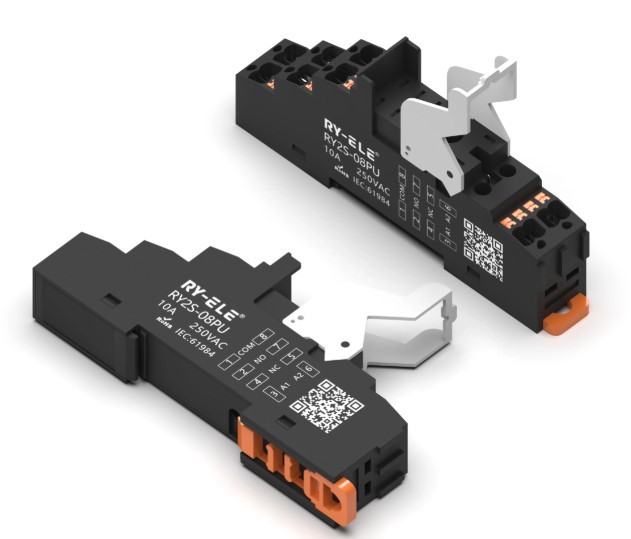

Control panels often need to accommodate relays, terminal blocks, circuit protection devices, controllers, and wiring within a limited enclosure. As machinery becomes more compact, engineers must use available space carefully without compromising electrical performance or service access.
A PCB mount relay socket gives designers a practical way to integrate relays directly with a printed circuit board. This approach can reduce wiring complexity and create a more organized component arrangement, which helps engineers develop compact control assemblies without sacrificing accessibility.
Why Does Control Panel Space Matter?
Control cabinets and machine enclosures come in many sizes. Smaller equipment often leaves little room for conventional wiring and individually mounted components.
An efficient PCB layout can place several control functions on one board. Integrating relay sockets into that design may help reduce the amount of panel space required for separate relay mounting arrangements.
How Does PCB Integration Save Space?
Traditional relay installations may require additional mounting hardware and individual wiring connections. A PCB-based approach brings the relay connection directly into the circuit board layout.
This arrangement can shorten connection paths and eliminate some of the wiring associated with separately mounted components. Engineers can then use the available enclosure area more efficiently.
How Can Relay Sockets Improve PCB Organization?
A relay socket establishes a defined position for the relay on the circuit board. Engineers can account for its footprint during the PCB design stage instead of adding the relay connection later.
Organized placement helps create cleaner component layouts. It can also make it easier to identify relay positions when technicians inspect or troubleshoot the control board.
What Should Engineers Consider When Designing a Compact PCB?
Saving space does not mean placing every component as close together as possible. Engineers need to maintain appropriate electrical clearances, thermal considerations, and access for assembly and servicing.
Important design considerations include:
- Socket footprint and dimensions
- Relay size and pin configuration
- Distance from neighboring components
- PCB trace routing
- Heat generated by nearby components
- Access for relay replacement
- Enclosure dimensions
A balanced layout can provide space efficiency while maintaining practical serviceability.
Can PCB Relay Integration Reduce Wiring?
Wiring often consumes considerable space inside control panels. Each separately mounted relay may require individual connections between the relay, terminals, and control circuitry.
PCB integration moves many of these connections onto the board itself. This can result in a cleaner assembly with fewer loose wires crossing the enclosure.
Reduced wiring may also make the control panel easier to inspect. Technicians can follow PCB traces and labeled connection points rather than tracing extensive point-to-point wiring.
Does a Compact Design Affect Maintenance?
Space savings should never make maintenance unnecessarily difficult. Engineers need to consider how technicians will access and replace relays after the equipment enters service.
A socket-based relay arrangement can help by providing a defined mounting location and allowing compatible relays to be removed without disturbing unrelated PCB components.
The design should still leave enough clearance around the relay for safe removal and inspection.
How Does Component Placement Influence Panel Size?
Every component contributes to the overall dimensions of a control assembly. Strategic placement can help designers reduce unused areas and make better use of the PCB surface.
Relays should remain sufficiently separated from heat-sensitive components and other devices that require special spacing. Engineers can use the socket footprint as part of the initial layout rather than treating relay placement as an afterthought.
Why Does Relay Compatibility Matter?
A compact PCB design only works when the socket and relay match correctly. Engineers should verify the relay’s dimensions, terminal arrangement, electrical ratings, and required footprint before completing the board layout.
Using compatible components prevents redesign work and helps ensure that the relay fits the intended location without interfering with adjacent parts.
What Role Does RY-ELE Play in Compact Control Designs?
RY-ELE provides relay-related components for control and automation applications. Engineers can consider its products when developing PCB-based control systems that require organized relay integration.
RY-ELE also gives designers an option when sourcing components for compact electrical assemblies. As with any component selection, engineers should review the relevant specifications and confirm compatibility with the complete PCB design.
When Is a PCB-Based Relay Arrangement Most Useful?
PCB relay integration can prove particularly useful in applications where enclosure space remains limited and multiple control functions need to fit within a compact assembly.
Examples include industrial automation equipment, machine controllers, electrical control modules, and other systems that combine several switching functions on a single board.
The approach works best when engineers plan the PCB, relay, socket, and enclosure together from the beginning.
Final Thoughts
Space-saving control panel design requires careful coordination between electrical requirements, PCB layout, component dimensions, and maintenance needs. Integrating relays with a PCB can help reduce wiring, organize components, and make better use of limited enclosure space.
A suitable relay socket gives engineers a defined interface for mounting and connecting the relay while supporting a cleaner board layout. By checking dimensions, electrical specifications, spacing, and service requirements early in the design process, engineers can create compact control systems that remain practical to manufacture and maintain.

