
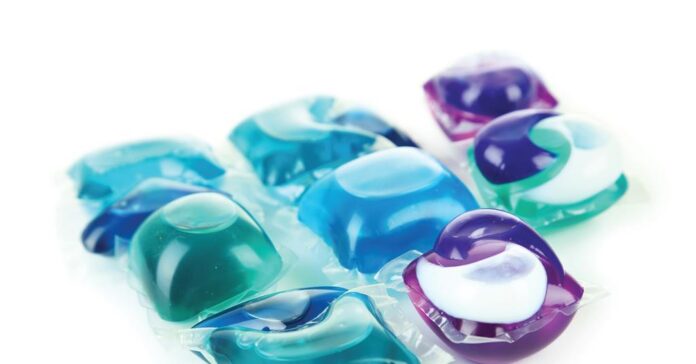

A laundry pod production line brings together several mechanical, electrical, and control components to turn water-soluble film and detergent into finished pods. Each component has a specific role in maintaining stable production and consistent package quality.
Understanding the main systems within a Laundry Pods Manufacturing Machine can help manufacturers evaluate equipment specifications more effectively. The film-handling, forming, filling, sealing, cutting, and control systems must work together to produce consistent results.
Film Feeding System
The film feeding system moves water-soluble film through the production line at a controlled rate. Stable film movement is important because variations in tension or positioning can affect subsequent forming and sealing operations.
Film rollers, guides, tension-control components, and related mechanisms may be used to keep the material aligned throughout the process.
Film Forming Unit
The forming unit shapes the water-soluble film into the required pouch configuration. Depending on the machine design, forming may involve molds or other forming mechanisms that create spaces for the detergent.
Consistent forming helps maintain uniform pod dimensions and provides the correct structure for the filling stage.
Filling System
The filling system delivers the detergent formulation into the formed film cavities. Its configuration depends on the physical characteristics of the product being packaged.
Important considerations include filling range, dosing accuracy, product viscosity, flow behavior, and the ability to maintain consistent quantities during continuous operation.
Detergent Supply System
A supply system transfers detergent from its storage or preparation area to the filling mechanism. Tanks, pumps, pipes, valves, and related components may be incorporated depending on the formulation and machine configuration.
The system should provide a stable product supply while minimizing interruptions and excessive material buildup.
Pump and Dosing Components
Pumps and dosing mechanisms control how detergent enters each pouch. Their operating characteristics need to match the detergent’s viscosity and flow properties.
Accurate dosing components are particularly important when producing pods with defined fill quantities or multiple chambers.
Sealing System
After filling, the film layers must be joined to create a closed pod. The sealing system controls the conditions under which the film surfaces are bonded.
Depending on the machine and film specification, relevant parameters may include sealing temperature, pressure, contact time, and alignment.
Temperature Control System
Some water-soluble films require carefully controlled sealing temperatures. Temperature-control components help maintain the selected operating range during production.
Stable temperature is important because fluctuations can affect sealing consistency and may require adjustments to machine settings.
Cutting System
Once the pouches have been sealed, the cutting system separates individual pods from the continuous film web.
Cutting accuracy affects pod dimensions and overall appearance. The cutting mechanism must remain synchronized with film movement and the production cycle.
Sensors
Sensors provide information about different stages of machine operation. They can be used to monitor film position, material presence, machine movement, and other operating conditions.
Accurate sensor feedback allows the control system to respond to changes and helps reduce errors caused by incorrect positioning or missing materials.
Control System
The control system coordinates the different machine functions. Operators can typically use a control interface to manage production parameters and monitor operating conditions.
A centralized control structure can make it easier to reproduce established settings when running the same product format.
Electrical Components
Motors, drives, switches, controllers, wiring, and other electrical components provide power and movement throughout the machine.
Reliable electrical components are essential for coordinating film feeding, filling, sealing, cutting, and other automated operations.
Mold or Tooling System
The tooling determines the shape and dimensions of the finished pod. Different product formats may require different molds or tooling configurations.
Manufacturers producing multiple pod sizes should consider how easily tooling can be changed and how the machine accommodates different formats.
Film Tension Control
Consistent film tension helps prevent wrinkles, misalignment, and dimensional variations. Tension-control components regulate how the film moves between different machine stages.
Maintaining suitable tension becomes particularly important during high-speed production.
Pneumatic Components
Some machines use compressed air to operate cylinders, valves, or other mechanisms. Pneumatic systems can provide controlled movement for selected machine functions.
The facility should confirm compressed-air requirements before installation and ensure that the available air supply meets the machine’s specifications.
Safety Components
Safety switches, guards, emergency stops, sensors, and other protective components help operators work around automated machinery.
Safety systems should remain functional throughout the machine’s operating life. Routine inspection and maintenance are important for keeping protective features effective.
Inspection and Monitoring Components
Some production configurations incorporate monitoring systems that help operators identify abnormalities during operation.
These systems can support checks related to film positioning, filling conditions, sealing, and other production stages. Additional quality-control procedures may still be required for finished pods.
Maintenance Access
Although not a production component itself, machine accessibility is an important design consideration. Operators and maintenance personnel need suitable access to filling parts, sealing surfaces, film guides, sensors, and other service points.
Accessible components can simplify routine cleaning, inspection, adjustment, and replacement procedures.
How the Components Work Together
The individual components are interconnected through a continuous production sequence. Film feeding begins the process, followed by forming and filling. The filled pouch then moves through sealing and cutting before the finished pod is collected.
If one stage becomes unstable, it can affect downstream operations. For this reason, component compatibility and synchronization are just as important as the specifications of individual parts.
Final Thoughts
A laundry pod manufacturing machine is made up of multiple systems that work together to support automated production. Film feeding, forming, filling, sealing, cutting, sensors, controls, and safety components all contribute to the overall performance of the equipment.
When comparing machines, manufacturers should examine how these components are configured rather than focusing on a single specification. POLYVA is one manufacturer that can be researched when evaluating equipment configurations for automated laundry pod production.

