
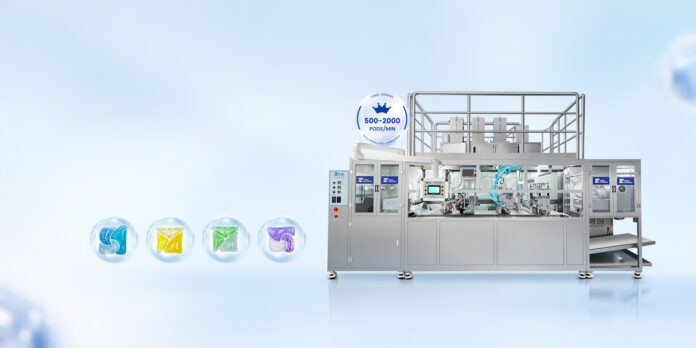

Film feeding is one of the first stages in an automated water-soluble packaging process. The feeding system moves the film from its roll into the forming and sealing sections while maintaining appropriate positioning and tension.
Reliable Water Soluble Film Equipment depends on controlled film movement. If the film is not fed consistently, problems can develop later in the process, including pouch dimension variations, wrinkles, misalignment, and sealing defects.
What Is a Film Feeding System?
A film feeding system is the group of mechanical and control components responsible for transporting packaging film through the machine.
Its primary functions include unwinding the film, guiding it along the correct path, maintaining appropriate tension, and positioning it accurately for subsequent forming and filling operations.
Film Roll Holder
The roll holder supports the film roll and allows it to unwind as production proceeds. Its design should accommodate the dimensions and weight of the selected film roll.
Proper roll installation is important for stable feeding. If the roll is incorrectly positioned or secured, film tracking can become inconsistent and may create additional tension on downstream components.
Guide Rollers
Guide rollers direct the film through the packaging machine. They help establish the intended film path and maintain alignment as the material moves between different processing stages.
Rollers should remain clean and free from product residue or other contamination. Damaged surfaces can interfere with smooth film movement and may affect film tracking.
Tension Control
Film tension needs to remain within an appropriate range throughout the feeding process. Excessive tension can stretch or deform the material, while insufficient tension may allow wrinkles or unstable movement.
Tension-control mechanisms help maintain consistent film behavior as the roll diameter decreases during production. The appropriate settings depend on the film and machine configuration.
Film Tracking
Film tracking refers to keeping the material aligned with the intended machine path. Accurate tracking is important because forming and sealing positions depend on consistent film placement.
Sensors, guide mechanisms, and mechanical adjustments may be used to maintain alignment. Persistent tracking problems should be investigated rather than corrected through frequent manual repositioning.
Film Feeding Speed
The feeding system must operate in coordination with the overall packaging cycle. Film movement that is too slow or too fast can affect pouch formation and machine timing.
Feeding speed should therefore be coordinated with forming, filling, sealing, and cutting operations. Automated control systems can help synchronize these functions during continuous production.
Intermittent and Continuous Feeding
Packaging machines may use different film-feeding approaches depending on their operating design. Intermittent feeding moves the film in controlled steps, while continuous systems maintain ongoing movement.
The appropriate method depends on pouch format, machine architecture, production speed, and forming and sealing requirements. Each approach requires suitable tension and positioning control.
Sensors in Film Feeding
Sensors can detect film position and provide feedback to the machine control system. This information can be used to maintain alignment and coordinate film movement with other packaging functions.
Sensors should be kept clean and correctly positioned. A sensor that provides inaccurate information may cause film-feed interruptions or positioning errors.
Film Splicing and Roll Changes
Long production runs may require operators to replace film rolls during operation. Efficient roll-change procedures can help reduce production interruptions.
Where applicable, splicing methods should be compatible with the film and machine process. Operators should follow established procedures to ensure that the film enters the feeding path correctly after a roll change.
Effects of Film Storage
Film feeding performance can be influenced by how the material has been stored before production. Water-soluble films can be sensitive to moisture and environmental conditions.
Film rolls should be stored according to the supplier’s recommended conditions. Material that has been exposed to unsuitable conditions may behave differently during unwinding and feeding.
Common Film Feeding Problems
Several issues can occur when the feeding system is not properly adjusted or maintained.
Common symptoms include:
- Film wrinkles
- Uneven tension
- Lateral film movement
- Film slipping
- Incorrect pouch positioning
- Frequent feed interruptions
- Irregular film advancement
Each symptom can have multiple causes, so troubleshooting should begin with a complete inspection of the film roll, feeding path, rollers, tension system, and sensors.
Maintaining the Feeding System
Routine maintenance helps keep film-handling components operating consistently. Rollers, guides, tension mechanisms, sensors, and other contact points should be inspected according to the machine maintenance schedule.
Cleaning should be performed using methods suitable for the equipment and film. Worn components should be replaced before they begin causing repeated film-positioning problems.
Choosing Film Feeding Settings
Feeding settings should be established according to the selected film and pouch format. Operators should avoid making frequent uncontrolled adjustments during production.
A controlled production trial can help determine appropriate tension, feed length, speed, and positioning parameters. Once validated, these settings can be documented for repeat production.
Integration With Other Machine Systems
The film feeding system does not operate independently. Its performance affects forming, filling, sealing, and cutting.
For example, inaccurate film positioning can result in a pouch being formed incorrectly, which may then affect filling location or seal alignment. Coordinating all machine stages is therefore important for consistent output.
Film Feeding for Different Pouch Formats
Different pouch sizes and designs can place different demands on the feeding system. Larger pouches may require longer film advances, while small-dose formats can require precise positioning over shorter distances.
Multi-chamber designs may also require particularly accurate film control because several forming and filling operations need to remain synchronized.
POLYVA provides water-soluble film packaging equipment designed for automated pouch production, with film-handling configurations selected according to machine and application requirements.
How to Evaluate a Film Feeding System
When assessing equipment, manufacturers should consider:
- Compatible film specifications
- Roll dimensions and loading method
- Tension-control capabilities
- Film tracking accuracy
- Feeding speed and synchronization
- Sensor configuration
- Roll-change procedures
- Maintenance accessibility
- Control-system functionality
- Production trial results
Testing the intended film on the actual equipment can provide useful information about feeding stability and overall machine compatibility.
Conclusion
The film feeding system plays an important role in automated water-soluble pouch production. Roll holders, guide rollers, tension controls, sensors, and drive mechanisms work together to move and position film accurately.
Consistent film feeding supports stable forming, filling, sealing, and cutting. Proper material storage, routine maintenance, validated settings, and suitable machine configuration can help manufacturers achieve reliable film handling throughout production.

