
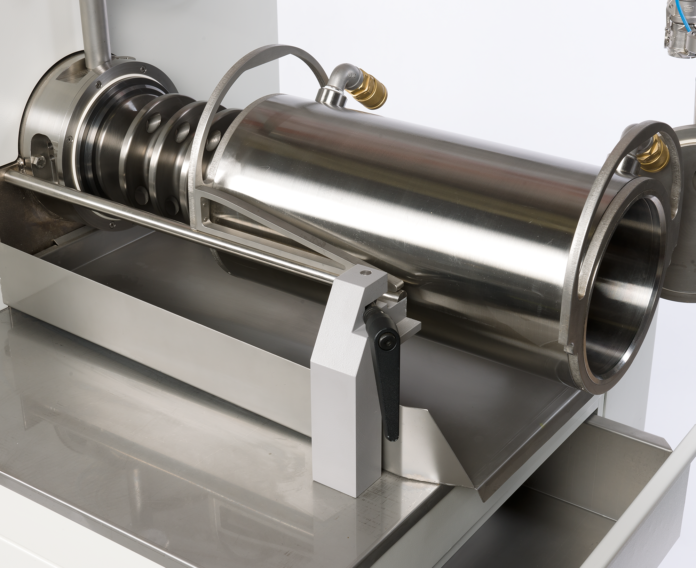

In modern industrial processing, achieving precise particle size reduction is essential for producing high-quality products in sectors such as paints, coatings, pharmaceuticals, chemicals, inks, and advanced materials. The efficiency and consistency of grinding depend not only on operating conditions but also on the design and functionality of the machine itself.
Every part of a milling system contributes to the overall performance, from energy transfer to material flow and particle dispersion. A properly engineered bead mill relies on the interaction of multiple components working together to deliver efficient grinding, stable operation, and uniform output quality.
Understanding the Importance of Bead Mill Components
The performance of a bead milling system is determined by how effectively its internal components work together. Each part plays a specific role in ensuring that particles are broken down efficiently and evenly distributed.
If even one component is not functioning optimally, it can affect grinding efficiency, particle size distribution, and overall product quality. This makes component design and maintenance critical for industrial applications.
Grinding Chamber and Its Function
The grinding chamber is the central working area of the bead mill where particle size reduction takes place. It is filled with grinding media and the material to be processed.
Its main roles include:
- Providing space for high-energy bead movement
- Ensuring controlled circulation of material
- Withstanding high mechanical and thermal stress
- Maintaining stable grinding conditions
A well-designed chamber ensures efficient energy transfer and uniform particle breakdown.
Rotor System and Energy Generation
The rotor is one of the most important components in a bead mill. It generates the mechanical energy required to move the grinding media at high speed.
Its key functions include:
- Creating strong shear and impact forces
- Accelerating grinding media inside the chamber
- Ensuring consistent energy distribution
- Supporting continuous grinding action
Rotor design directly influences grinding efficiency and particle size reduction performance.
Grinding Media and Particle Breakdown
Grinding media, typically small beads, play a central role in the milling process. These beads are responsible for the actual mechanical impact that breaks down particles.
Important characteristics include:
- Size and material composition
- Density and hardness
- Wear resistance and durability
Smaller beads are used for finer grinding, while harder materials improve efficiency and reduce contamination risks.
Separation System and Product Quality
The separation system ensures that ground material is separated from the grinding media before discharge. This component is critical for maintaining product purity and preventing media loss.
Its functions include:
- Filtering out grinding media from processed material
- Ensuring clean and consistent product output
- Preventing contamination or particle imbalance
- Supporting continuous operation
Efficient separation is essential for maintaining stable production quality.
Cooling System and Temperature Control
During operation, high energy levels generate heat inside the milling chamber. The cooling system helps maintain stable temperature conditions to protect both the material and the machine.
Its key roles include:
- Preventing overheating of sensitive materials
- Maintaining consistent viscosity during processing
- Protecting mechanical components from thermal damage
- Ensuring stable grinding performance
Proper temperature control improves both efficiency and product quality.
Shaft and Mechanical Stability
The shaft connects the motor to the rotor and plays a vital role in transferring mechanical energy. Its stability directly affects machine performance.
Key functions include:
- Transferring rotational energy efficiently
- Maintaining alignment of moving parts
- Reducing vibration during operation
- Supporting continuous high-speed grinding
A well-balanced shaft system ensures smooth and reliable operation.
Seals and Leakage Prevention
Seals are essential for preventing leakage of material and protecting internal components from contamination.
Their functions include:
- Preventing product leakage during operation
- Protecting bearings and internal parts
- Maintaining pressure stability inside the chamber
- Extending equipment lifespan
High-quality sealing systems are crucial for safe and efficient operation.
How Components Work Together
The performance of a bead milling system depends on the coordinated function of all components. The rotor generates energy, the grinding media breaks down particles, the chamber provides structure, and the separation system ensures clean output.
This synchronized operation ensures:
- Efficient particle size reduction
- Uniform dispersion quality
- Stable and continuous processing
- Reduced operational issues
Each component contributes to the overall efficiency of the system.
Importance of Maintenance for Component Efficiency
Even the best-designed components require regular maintenance to ensure long-term performance. Wear and tear can reduce efficiency over time if not properly managed.
Key maintenance practices include:
- Regular inspection of grinding media
- Monitoring rotor and chamber condition
- Checking seals for wear or leakage
- Ensuring proper cooling system function
Proper maintenance helps extend machine life and maintain consistent output quality.
Conclusion
The performance of a bead milling system depends heavily on the design and condition of its internal components. Each part, from the rotor and grinding chamber to the separation and cooling systems, plays a vital role in ensuring efficient particle size reduction and stable operation.
A well-engineered bead mill delivers high-quality grinding results by integrating all components into a unified system. Understanding their roles helps improve operation, maintenance, and overall production efficiency in modern industrial applications.

