
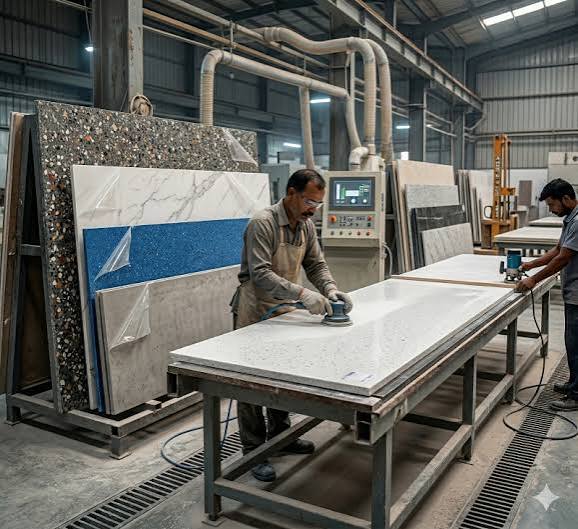

The solid surface industry has evolved significantly as manufacturers adopt modern equipment, automated production systems, and improved material processing techniques. These developments have made it possible to produce a wider variety of sheets, countertops, sinks, and customized architectural components with greater consistency. As demand for durable and visually appealing interior materials increases, technology plays an increasingly important role in improving manufacturing efficiency and product quality.
Modern production requires more than basic machinery. Manufacturers must combine material science, process automation, precision engineering, and quality management to meet changing customer expectations. An experienced Solid Surface Manufacturer can use these technologies to improve production control, support customized designs, and maintain consistent product specifications across different orders.
1. Automated Raw Material Measurement
Accurate raw material measurement is one of the first requirements for producing consistent solid surface materials. The manufacturing process typically involves combining resin systems, mineral fillers, pigments, and other additives in carefully controlled proportions.
Traditional manual measurement can introduce inconsistencies, particularly when production volumes are high. Modern weighing and dosing systems help manufacturers measure ingredients more accurately and repeat the same formulations across multiple batches.
Automated systems can support:
- Precise ingredient measurement
- Consistent batch preparation
- Reduced manual handling errors
- Better production records
- More efficient material usage
Accurate measurement provides a reliable foundation for subsequent manufacturing stages.
2. Advanced Mixing and Material Preparation
Mixing technology directly influences the uniformity of solid surface compounds. Mineral fillers, resins, and pigments must be distributed evenly to achieve the intended material characteristics.
Modern industrial mixing equipment allows manufacturers to control mixing speed, duration, and other operating parameters. Some production systems also use vacuum mixing to reduce trapped air within the material.
These technologies can help minimize problems such as uneven pigment distribution and internal voids.
Controlled mixing is particularly important when producing customized colors or decorative patterns, where material consistency influences the final appearance.
3. Computer-Controlled Molding Systems
Molding technology determines how prepared material is shaped into sheets or customized components.
Modern production facilities may use controlled molding systems to maintain consistent dimensions and improve repeatability. Depending on the product, manufacturers can produce standard panels, integrated components, and specially shaped products.
Computer-controlled equipment can help manage:
- Mold dimensions
- Material distribution
- Production settings
- Processing sequences
- Product thickness
- Repeat manufacturing requirements
Consistent molding helps reduce dimensional variations and supports more predictable downstream processing.
4. Improved Curing Technology
Curing is an essential stage in solid surface manufacturing because it allows the resin system to develop its solid structure.
The required curing conditions depend on the material formulation and production method. Temperature, processing time, and material thickness must be controlled according to the manufacturer’s established procedures.
Modern monitoring systems can help operators track relevant production conditions and identify deviations.
Improved process control supports more consistent curing and reduces the risk of defects associated with unsuitable processing conditions.
5. CNC Cutting and Precision Fabrication
Computer numerical control (CNC) technology has become increasingly useful in solid surface fabrication.
CNC machines follow digital design instructions to perform cutting, routing, drilling, and shaping operations. This allows manufacturers and fabricators to produce components with accurate dimensions and repeatable details.
Common applications include:
- Countertop cutting
- Sink openings
- Custom edge profiles
- Decorative shapes
- Curved component preparation
- Precise drilling and routing
CNC technology is particularly valuable for projects involving complex designs or multiple components that must fit together accurately.
It can also help reduce material waste by optimizing cutting layouts.
6. Digital Design and 3D Modeling
Digital design software helps manufacturers develop and evaluate product concepts before physical production begins.
Computer-aided design (CAD) tools allow designers and engineers to create detailed models of countertops, basins, furniture components, and architectural surfaces.
Three-dimensional modeling can help teams examine dimensions, proportions, connections, and fabrication requirements.
Before manufacturing starts, digital models may be used to:
- Review customized product shapes
- Check dimensional relationships
- Identify potential design conflicts
- Prepare fabrication instructions
- Estimate material requirements
- Communicate design details with customers
This process can reduce misunderstandings and make customized production more organized.
7. Advanced Sanding and Polishing Equipment
Surface finishing plays a major role in the appearance of solid surface products. Modern sanding and polishing equipment helps manufacturers achieve more uniform finishes across sheets and fabricated components.
Automated or semi-automated finishing systems can control abrasive movement, pressure, and processing sequences. These systems may improve repeatability compared with entirely manual operations.
Manufacturers can produce different finishes, including:
- Matte
- Satin
- Semi-gloss
- High-gloss
The selected finish should match the product’s intended application and maintenance requirements. Consistent finishing is particularly important when several components must appear visually coordinated.
8. Automated Quality Inspection
Technology has improved how manufacturers monitor product quality during production.
Digital measuring instruments, optical inspection systems, and other testing equipment can help identify dimensional differences and visible defects.
Depending on the facility and product specifications, inspection technology may be used to evaluate:
- Sheet thickness
- Length and width
- Surface irregularities
- Color consistency
- Edge quality
- Product geometry
Automated inspection can support faster identification of production variations. However, trained personnel remain important for interpreting results, checking application-specific requirements, and deciding whether a product meets the required specifications.
9. Laboratory Testing and Material Evaluation
Manufacturers use testing equipment to assess whether solid surface products meet defined performance requirements.
The tests selected depend on material composition, intended use, and relevant customer or market standards.
Common evaluation areas include:
| Test or evaluation | Purpose |
|---|---|
| Hardness testing | Examines resistance to indentation |
| Flexural testing | Measures behavior under bending loads |
| Water absorption testing | Evaluates moisture absorption |
| Chemical resistance testing | Examines responses to selected substances |
| Dimensional inspection | Checks product measurements |
| Visual assessment | Identifies surface defects and inconsistencies |
Modern laboratory equipment can improve measurement accuracy and support more reliable product evaluation.
Buyers should request product-specific test reports and confirm which methods and standards were used.
10. Technology for Customized Color and Pattern Development
Modern manufacturing technology gives solid surface producers greater flexibility in developing colors and decorative effects.
Digital color measurement and controlled pigment dosing can help manufacturers reproduce approved shades more consistently.
Depending on the production system, manufacturers may create:
- Solid colors
- Multi-tone patterns
- Stone-inspired appearances
- Speckled effects
- Custom decorative designs
Digital color references can be especially useful for repeat orders and projects that require coordinated products across different spaces.
However, the final appearance should always be checked through physical samples because lighting, surface finish, and production conditions can influence how colors are perceived.
11. Robotics and Material Handling Automation
Robotics and automated handling systems can improve workflow in larger manufacturing facilities.
Solid surface sheets and molded components may be heavy or difficult to move safely. Automated lifting and handling equipment can reduce repetitive manual tasks and help protect products during internal transportation.
Potential applications include:
- Moving raw materials
- Transferring sheets between production stages
- Positioning components for machining
- Sorting finished products
- Supporting packaging operations
Automation can improve workplace efficiency, but it must be supported by appropriate safety systems and trained operators.
12. Digital Production Monitoring
Digital monitoring systems help manufacturers track production activities and identify operational problems.
These systems may collect information about machine performance, processing conditions, production quantities, and equipment downtime.
Production managers can use this information to:
- Monitor manufacturing progress
- Identify recurring equipment problems
- Track material consumption
- Review production efficiency
- Improve scheduling
- Maintain production records
Better access to operational information can support faster decision-making and help manufacturers maintain more predictable production schedules.
13. Artificial Intelligence and Data-Based Manufacturing
Artificial intelligence and data analytics are emerging as potential tools for improving industrial production.
In solid surface manufacturing, these technologies may help analyze production information, identify patterns, and support process optimization.
Possible applications include:
- Predictive equipment maintenance
- Production quality trend analysis
- Material consumption forecasting
- Defect pattern identification
- Manufacturing schedule optimization
For example, analyzing equipment performance data may help maintenance teams identify warning signs before a machine failure interrupts production.
These applications depend on reliable data, suitable software, and effective integration with existing manufacturing systems. AI should support established quality procedures rather than replace technical inspection and engineering judgment.
14. Energy Efficiency and Environmental Management
Advanced technology can also help manufacturers improve resource efficiency.
Production facilities may use modern motors, energy monitoring systems, improved ventilation, and more efficient machinery to reduce unnecessary energy consumption.
Other technological improvements may support better material utilization and waste management.
Examples include:
- Optimized cutting layouts
- Automated material dosing
- Dust extraction systems
- Energy-efficient equipment
- Production waste monitoring
- Improved storage and handling systems
These measures can reduce operational waste and support more responsible manufacturing practices.
Buyers interested in environmentally responsible sourcing should request relevant documentation and evidence of the manufacturer’s actual practices.
15. How Advanced Technology Benefits Buyers
Technology improvements are valuable because they can translate into practical benefits for customers.
For distributors, contractors, and project developers, modern production systems may provide:
Greater consistency: Controlled formulations and automated processes help maintain repeatable product specifications.
Improved precision: CNC equipment supports accurate dimensions and customized fabrication.
More design flexibility: Digital modeling and modern molding methods allow manufacturers to develop a wider range of product shapes.
Better quality monitoring: Inspection equipment helps identify variations during production.
More efficient production: Automation can reduce repetitive work and improve workflow.
Improved order management: Digital production records can support planning, tracking, and communication.
The actual benefits depend on how effectively a manufacturer integrates technology into its operations.
16. What Buyers Should Check When Evaluating Manufacturing Technology
A modern-looking factory does not automatically guarantee high-quality products. Buyers should evaluate whether the technology is appropriate for the manufacturer’s product range and whether it is supported by effective operating procedures.
Consider the following checklist:
| Evaluation area | Questions to ask |
|---|---|
| Material preparation | Are weighing and mixing processes controlled? |
| Molding | How are dimensions and thickness maintained? |
| Curing | Are processing conditions monitored? |
| Fabrication | Is CNC or precision cutting equipment available? |
| Finishing | How is surface consistency maintained? |
| Quality inspection | Which measuring and testing tools are used? |
| Digital systems | Are production records maintained? |
| Equipment maintenance | How often is machinery inspected? |
| Workforce | Are operators properly trained? |
| Environmental management | What systems reduce waste and energy use? |
Visiting a production facility, reviewing product samples, and requesting relevant technical documentation can help buyers verify the manufacturer’s capabilities.
Conclusion
Advanced technology plays an important role in modern solid surface manufacturing by improving material preparation, molding, curing, precision fabrication, surface finishing, and quality inspection. Digital design tools, automated equipment, and production monitoring systems also help manufacturers manage customized orders and improve operational efficiency.
For buyers, the most important consideration is not simply whether a factory uses advanced machinery, but how effectively its technology supports consistent product quality and reliable production. Combining modern equipment with skilled personnel, controlled processes, and proper testing provides a stronger foundation for dependable solid surface products.
As manufacturing technology continues to develop, suppliers that invest in practical innovation and continuous process improvement will be better positioned to respond to changing design requirements and customer expectations.

