
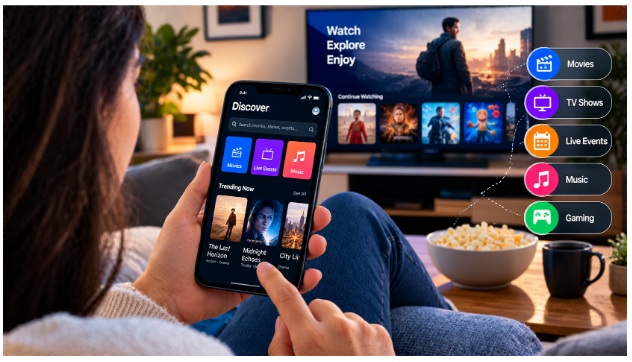

Jordan Okafor, a 27-year-old grad student in Brooklyn, used to spend more time choosing what to watch than actually watching it. Forty minutes of scrolling, three trailers, one half-finished movie, and a vague feeling of having wasted the evening. Then a friend sent her a short clip from a lesser-known Korean thriller, she saved it to a watchlist app, and her phone started surfacing similar films, local screenings, and even a cheap rush ticket to a play in the East Village. Within a month, her weekends had more variety than they’d had in years. She wasn’t consuming more. She was finding better.
That shift is what every mobile app development company in New York hears about from media startups, theatre groups, and music platforms. Discovery has become the heart of entertainment, because there’s more to watch, hear, play, and attend than any person could possibly sample. This guide looks at how mobile apps are reshaping the hunt for the next great show, song, game, or night out, where the system works, where it misleads, and what it takes to build a product in this space.
The Problem of Too Much Choice
A generation ago, entertainment was scarce. You had a handful of TV channels, a local cinema, a record store, and a library. Choosing was easy because options were limited.
Today the opposite is true. Netflix, Disney+, Max, Hulu, Prime Video, and Apple TV+ compete with YouTube, TikTok, and Twitch. Spotify and Apple Music hold tens of millions of tracks. Podcasts number in the millions. App stores overflow with games. In a city like New York, live events add Broadway, Off-Broadway, concerts at Madison Square Garden, indie gigs in Brooklyn, comedy cellars, and film festivals like Tribeca.
Psychologists call the resulting stress the paradox of choice. More options should make us happier, yet often they leave us paralyzed. Mobile apps exist partly to solve that problem. Their job is no longer to deliver content, since content is everywhere. Their job is to help people find the right thing at the right moment.
Recommendation Engines: The Invisible Curators
The biggest change in discovery is the algorithm. Behind every “Because you watched” row sits a system that studies what you play, skip, rewatch, rate, and search for, then compares you to millions of others with similar habits.
This approach, often built on collaborative filtering and machine learning, powers Netflix’s home screen, YouTube’s suggestions, and Spotify’s playlists. Netflix has said that the majority of what members watch comes through recommendations rather than search. Spotify’s Discover Weekly, launched in 2015, built a weekly ritual out of a personalized mixtape, and its annual Wrapped campaign turned listening data into something people proudly share.
TikTok pushed the idea further. Its For You page learns from tiny signals, such as how long you linger on a video, and serves a stream tuned to your taste within minutes. Users don’t have to search or follow anyone. They just open the app and discovery begins.
For listeners and viewers, the benefit is obvious: less hunting, more enjoying. The risk is just as clear, which we’ll get to shortly.
Social Discovery: Friends, Creators, and Communities
Not all discovery is algorithmic. Humans have always recommended things to each other, and apps now speed that up.
Short clips travel through messaging apps and social feeds. A friend drops a scene from a new series into a group chat, and suddenly everyone’s watching. Letterboxd lets film fans log, rate, and review movies, building taste profiles and lists that others follow. Goodreads does the same for books, and Reddit communities dissect everything from anime to indie games.
Creators have become powerful curators. A YouTuber who reviews horror films or a TikTok account that recommends obscure albums can send thousands of people to a title overnight. Audiences trust them because they feel like a person with taste rather than an advertisement.
Jordan’s discovery habits changed most through this route. She followed three film critics, joined a small club on Letterboxd, and started trading watch recommendations with strangers who liked the same slow-burn thrillers she did.
Aggregators Solve the Streaming Maze
Streaming created a new annoyance: nobody knows where anything is. A film might sit on Netflix this month, Max next month, and only for rent after that.
Aggregator apps like JustWatch and Reelgood fixed it. You search for a title, see which services carry it, and add it to a cross-service watchlist. Many also suggest what to watch based on your subscriptions, mood, and ratings. Apple’s TV app and Google TV do similar work at the system level.
These tools quietly give viewers more control. Instead of loyally browsing one platform, people shop across all of them, canceling services when nothing appealing is left and returning when a favorite show drops. That change in behavior forces streaming companies to compete on quality and discovery, not just catalog size.
Live Events: From Posters to Push Notifications
Discovery isn’t only about screens. Live entertainment has moved onto phones as well.
Ticketing apps like Ticketmaster, SeatGeek, and Eventbrite show what’s on near you, with maps, seat views, and mobile tickets. Bandsintown and Songkick notify you when artists you follow announce tour dates. Resident Advisor guides electronic music fans through club nights. In New York, TodayTix grew up around theatre, with rush tickets and digital lotteries that opened Broadway to people who couldn’t afford full price.
Location is the secret ingredient. A phone knows where you are, what time it is, and what you’ve enjoyed before. It can suggest a jazz set in Greenwich Village an hour from now or a free outdoor movie in Prospect Park tonight. Spontaneity, once the domain of lucky strolls, now comes with a notification.
For venues and promoters, the effect is huge. An independent theatre can fill unsold seats at the last minute. A small band can reach fans in cities they’ve never visited. Discovery no longer depends on a big marketing budget.
Games, Music, and the Rise of Try-Before-You-Buy
Gaming shows a distinct discovery pattern. Mobile app stores, Apple Arcade, Google Play Pass, and cloud services like Xbox Cloud Gaming let players sample titles instantly. Free demos, short trailers, and social proof from friends reduce the risk of buying a game that disappoints.
Music works similarly. Shazam, owned by Apple, identifies a song playing in a café with one tap and sends you to the full track. Playlists, radio stations, and short clips on TikTok or Instagram Reels introduce artists to listeners who would never have found them through radio. A 15-second clip can launch a decades-old song back onto the charts.
Podcasts and audiobooks follow the same logic. Apps recommend shows based on listening time, and clips shared on social media act like trailers. People start with a single episode, then end up subscribed.
Personalization Versus the Filter Bubble
All this tailoring has a downside. When an algorithm only serves what you already like, your world can shrink. You might never encounter a genre, culture, or voice outside your usual taste. Researchers call this a filter bubble, and it’s a real concern for entertainment as much as news.
Responsible platforms try to build in serendipity. They add curated editor picks, “something different” sections, regional spotlights, and prompts that nudge users toward unfamiliar territory. Human curators still matter, whether they’re critics, radio hosts, or friends with great taste.
Users can help themselves too. Follow people whose taste differs from yours, browse charts occasionally, and treat the recommendation list as a starting point rather than a verdict.
Subscription Fatigue, Screen Time, and Wellbeing
Discovery apps solve one problem and sometimes create another. Endless feeds can eat hours without much satisfaction. Several subscriptions can cost more than a night out. Parents worry about what children find.
Tools exist to help. Screen Time on iPhone and Digital Wellbeing on Android show how long you spend in each app and let you set limits. Many streaming services offer kids’ profiles with age-appropriate content, and US rules like COPPA restrict how companies collect data from children under thirteen.
A healthy habit is to decide what you want before you open an app. Go in with a purpose, whether it’s a comedy for tonight or a new album for the commute, and the app serves you instead of the reverse.
Accessibility and Inclusion in Entertainment Apps
Great discovery should reach everyone. Subtitles, closed captions, audio description for blind and low-vision viewers, adjustable text sizes, and screen reader support open entertainment to people who were once excluded.
Language and culture matter as well. Apps that support multiple languages and highlight global content help audiences find stories beyond their own region. Streaming has already shown that a Korean series, a Spanish thriller, or a Nigerian film can become a worldwide hit when discovery works well.
What It Takes to Build an Entertainment Discovery App
If you’re a startup, studio, venue, or media brand thinking about building your own app, begin with a narrow audience and a sharp promise. “Everything for everyone” rarely wins. “The best small theatre shows in the five boroughs” might.
The features that tend to matter most include personalized feeds, search with smart filters, watchlists or saved lists, social sharing, push notifications tied to location and interests, ticketing or deep links to services, and clear controls over data.
Budget shapes the plan. When you sit down with vendors, write Factors Affect Mobile App Development Cost at the top of a page and list what applies to you: the number of features, whether you need iPhone, Android, or both, the complexity of recommendation logic, third-party integrations such as payments or streaming APIs, design depth, backend and hosting needs, and the team’s location and experience. A focused first release might start around thirty thousand dollars. A platform with machine learning recommendations, live content, and large-scale infrastructure can pass one hundred fifty thousand, plus ongoing upkeep each year.
A few practical lessons from teams who’ve done this well:
- Solve the first-session problem. Show value in the first minute, before asking for a long sign-up.
- Use real signals. Combine behavior data with editor picks so recommendations feel smart and human.
- Respect privacy. Be clear about what you collect, comply with laws like CCPA and GDPR, and let users export or delete data.
- Handle rights carefully. Licensing, content moderation, and age restrictions shape what you can show.
- Test for speed. Video previews and long lists must load quickly, even on average connections.
- Measure what matters. Track retention, saved items, clicks to purchase, and satisfaction, not just downloads.
Challenges That Still Need Solving
Algorithm opacity. Users rarely know why something appears in their feed. More transparency would build trust.
Platform fragmentation. Content is spread across too many services, and cross-service discovery remains clunky.
Creator fairness. Small artists struggle to be seen when algorithms favor already-popular content.
Misinformation and harmful content. Platforms must moderate effectively without silencing legitimate voices.
Attention economics. Apps designed to maximize time spent can clash with what users really want.
Frequently Asked Questions
How do apps recommend movies and shows?
They analyze what you watch, rate, search for, and skip, then compare your behavior with similar users. Machine learning models predict what you’re likely to enjoy next.
What is the best app for finding something to watch?
It depends on your needs. JustWatch and Reelgood help find where titles stream, Letterboxd suits film fans who like community, and the built-in recommendations on Netflix and YouTube work well for casual browsing.
How can I discover new music beyond what I usually listen to?
Try editor-curated playlists, follow friends and critics, use features like Discover Weekly, and explore regional or genre charts. Occasionally searching an unfamiliar genre trains the algorithm to widen its picks.
How do apps help people find local events?
They use your location and interests to suggest concerts, shows, festivals, and screenings nearby, and send notifications when artists or venues you follow announce something new.
Are recommendation algorithms bad for diversity?
They can narrow what people see if they only reinforce existing taste. Well-designed apps mix personalization with curation and surprise to keep discovery varied.
How long does it take to build an entertainment app?
A simple version often takes two to four months. A complex product with recommendation engines, video, and ticketing can take six months to a year.
Final Thoughts
Entertainment used to be about access. Now it’s about attention, and apps have become the guides who help us spend it well. The best ones feel like a friend with great taste who knows when you’re in the mood for something silly, something slow, or something you’ve never heard of.
Jordan still wastes an occasional evening scrolling. Everyone does. But these days she keeps a short list on her phone, a mix of a thriller recommended by a stranger, a free concert across the river, and a documentary a friend swore would change her mind. On Friday, she’ll pick one without a second thought. That quiet ease, more than any single feature, is how mobile apps changed the way people find what to enjoy.

